
The Path to a Cure
The scientific pathway to a cure has been developed and is already underway.
We are committed to curing curable single-gene disorders. While each gene is unique, they all share the fact that these children are missing one single protein in their cells to function appropriately. The science exists to fix this; it just takes passion, focus, and the funding to treat each one.
We are honored to share that Moonshots for Unicorns co-founder Dr. Geri Landman will be a featured panelist at the UCSF Center for Genome Surgery’s inaugural symposium on September 1, 2026.
The symposium will bring together leaders in genome editing, gene therapy, clinical translation, ethics, and patient advocacy—including keynote speakers Jennifer Doudna and Laura Sepp-Lorenzino. Geri will sit on a panel representing the rare-disease family perspective and discuss what it takes to move a treatment from a scientific possibility toward an actual therapy for children.
Meanwhile, our work toward a cure for PGAP3 continues on several fronts. Researchers at The Jackson Laboratory are moving forward with studies using mice engineered with Lucy’s exact PGAP3 mutations. These models allow us to test emerging base-editing approaches and evaluate their safety and effectiveness in a living system.
We are also exploring advanced capsids designed to deliver therapy more effectively throughout the brain. Choosing the right delivery system is one of the most important challenges in treating neurologic genetic diseases, and newer capsids may allow us to reach far more brain cells than traditional AAV9-based approaches. We are privileged to be collaborating with Ben Deverman’s lab at the Broad Institute to test our base editor in a viral vector that uses the human transferrin receptor to cross the blood brain barrier, allowing for delivery to deep regions of the brain that are essential to treating the symptoms of PGAP3.
Each of these projects moves us closer to the same goal: a safe, durable treatment for every child with PGAP3. We are grateful to the scientists, collaborators, families, and donors who continue to make this work possible. Rare should never mean forgotten—and it should never mean untreatable.
July 2026: Moonshots continues collaboration with UC Berkeley, UCSF, and Jackson Labs
September 2025: Base Editing Brings Us Closer to a Cure
We are incredibly fortunate to be working with scientists in Dr. Fyodor Urnov’s laboratory at UC Berkeley and the Innovative Genomics Institute, together with researchers at The Jackson Laboratory, to develop a treatment for Lucy and every child affected by PGAP3.
The team has now shown that both of Lucy’s specific PGAP3 mutations can be corrected using base editing—and that the base editors successfully correct these mutations in Lucy’s own cells.
Base editing is a form of precision genetic medicine that can repair a single error in DNA without cutting both strands of the DNA molecule. It is the same groundbreaking approach used to treat Baby KJ at Children’s Hospital of Philadelphia, the first child to receive a personalized CRISPR-based therapy.
Our Path to a Cure
✅ Confirm that Lucy’s mutations can be corrected through base editing — They can
✅ Demonstrate that the base editors work in Lucy’s cells — They do
✅ Create mice carrying Lucy’s exact PGAP3 mutations and confirm that they develop measurable features of the disease — Complete
⬜ Test the base editors in mice for safety and effectiveness — Fall 2026
⬜ Identify the safest and most effective way to deliver the treatment throughout the brain
⬜ Complete the studies and regulatory work required to apply for a human clinical trial
Base editing may offer important advantages over traditional AAV9 gene-replacement therapy. Because it corrects the underlying DNA mutation, the repair could be durable over a lifetime. We are also evaluating newer delivery technologies designed to reach more cells across the brain—one of the greatest challenges in treating neurologic genetic diseases.
There is still significant work ahead, but these are no longer theoretical possibilities. Lucy’s mutations can be corrected. The technology works in her cells. We now have mice carrying her exact mutations in which to test it.
Step by step, this is becoming a path to a cure.

May 2024
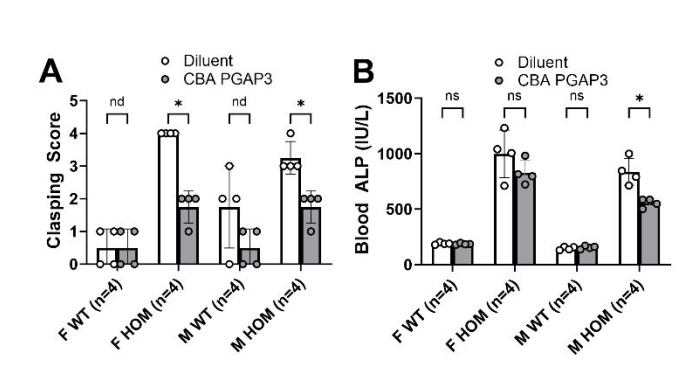
Exciting news: We have reached the “Proof of Concept” phase of our research! The gene therapy cures the PGAP3 mice!
PGAP3 mice show neurologic abnormalities, including an abnormal “clasping” phenotype. The gene therapy fixes this and makes them neurologically like the wild-type mice! It also lowers the alkaline phosphatase in their blood, a known marker of PGAP3 disease.
This means that we have created a gene therapy medication that is not only safe, it cures patient cells (making them look and behave like normal cells) and corrects the neurologic deficits of the PGAP3 mice. A substance exists in the world that could cure Lucy and other kids with PGAP3. This blows my mind, and feels like so much progress in two years.
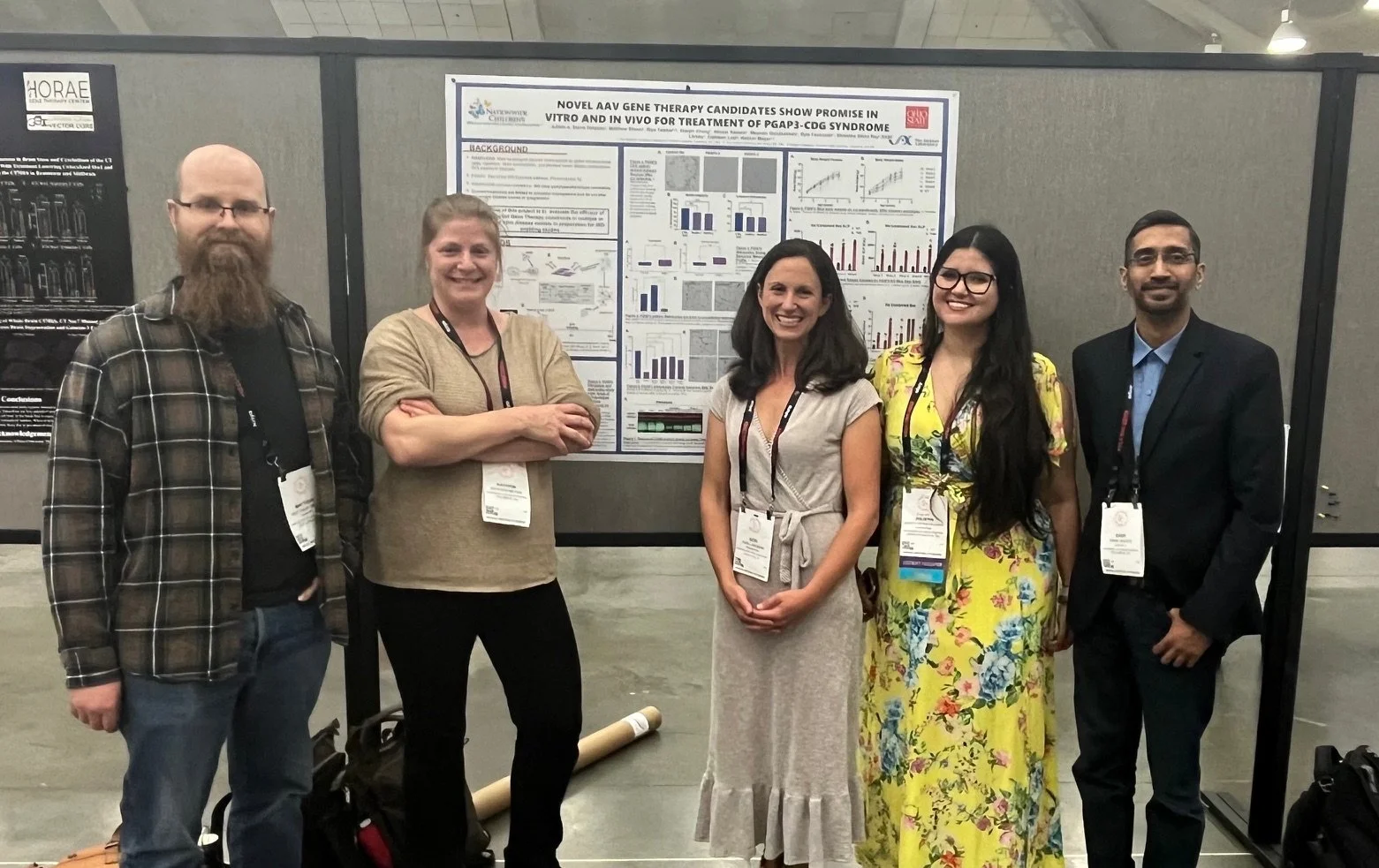
Others are also impressed: our research was presented at the major gene therapy conference this year (American Society of Gene and Cell Therapy) and it won the Outstanding Poster Award! We are so grateful to all of the incredible scientists working on this devastating disease, and to our generous donors, who have enabled this rapid progress toward a cure!
August 2023
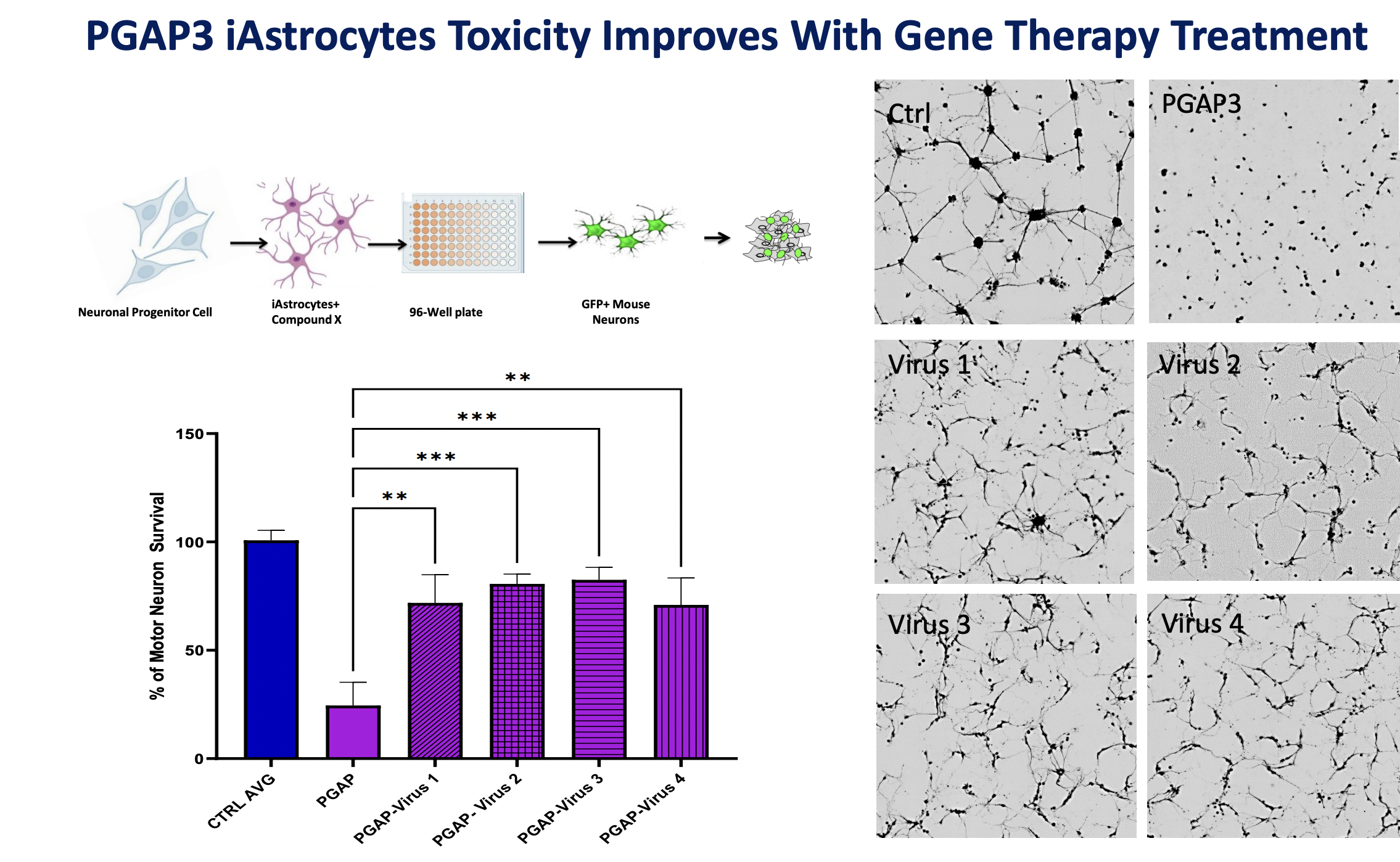
THE GENE THERAPY WORKS ON LUCY’S CELLS!
Such amazing news: the gene therapy works on Lucy's cells! All 4 of the vectors we tried improve survival of her neurons in the lab and make them connect/communicate much more normally! I am crying as I look at these images, knowing what it means for Lucy and other kids with PGAP3.
Stayed tuned for end of October, when we'll know whether it works on the PGAP3 mice. The Jax Lab recently let us know they are showing a robust phenotype - they have elevated alk phos just like kids with PGAP3 and have an abnormal grasping reflex, so it should be easy to tell if the gene therapy is working!! At that point, we'll need about $500K more to start CLINICAL MANUFACTURING of the gene therapy medicine that is actually going to be given to our kiddos.
April 23, 2023
So many exciting developments to share from the last few months, thanks to our generous donors!
Drug repurposing: Working with Perlara and UCSF, we completed a 12,000 compound screen of the PGAP3 knockout yeast (yeast that lack a functional PGAP3 gene, just like Lucy). These yeast generally grow poorly compared to typical yeast. Several of these compounds helped the PGAP3 yeast grow normally, including a few that may be very safe (eg, gold nanoparticles, or a blood pressure drug called lercanidipine). The next step will be to test these compounds on Lucy’s cells to see if they also help them function more normally!
Read the full report. A collaboration among Moonshots for Unicorns, UCSF School of Medicine, and Perlara!
Gene therapy: Four experimental gene therapy vectors have been successfully created. The MOST exciting news: Two of them were given to a couple of wild type (regular) mice back in January and those mice are still doing JUST FINE – acting, living, behaving completely normally! This is huge because it means the gene therapy for PGAP3 is likely safe – you can give it to a healthy animal and the animal is still healthy! We should hear in the next few weeks whether the gene therapy is both safe and efficacious for Lucy’s cells growing in the lab – does it help her neurons and astrocytes behave as they should, instead of clumping and dying? Finally, the gene therapy vectors have also been sent to Jax Labs in Maine, where they will be given to the PGAP3 knockout mice. We should know by the end of the summer whether the mice are cured by the gene therapy – stay tuned for updates!!
- Zach & Geri
November 4, 2022
Wow! What a few months! There has been incredible progress both at the Moonshots’ San Francisco lab in partnership with UCSF and separately with Dr. Meyer’s gene therapy team at Nationwide Children’s. In fact, on a single day, both scientific teams which approach PGAP3 differently (one from Lucy’s own cells turned into brain cells, the other with a model of PGAP3 cells using yeast) discovered the same mechanism of disease and types of medications which could help Lucy and children with PGAP3.
With the twin groundbreaking discoveries, we were confident that we could trust the medicines that the SF team found helped the PGAP3 yeast. Given that a few of them were safe and over-the-counter and with the guidance of Lucy’s clinical team, we started giving these to Lucy within 48 hours of the discovery.
Lucy previously could never walk or stand independently. One week later, Lucy took her first steps!
Read more on the full story here!
- Zach & Geri
Lucy Takes Steps
After 2 weeks on repurposed medicine, Lucy is beginning to take multiple (yet still clumsy) steps! A big improvement!
August 26, 2022
There are so many exciting developments over the past month! First, Dr. Kathrin Meyer’s lab has discovered many groundbreaking findings on PGAP3 in terms of neuron and astrocyte function in PGAP3. From Lucy’s cells, they have developed neurons, astrocytes, fibroblasts and other cells. Every day, we are learning of true DISCOVERIES about PGAP3, both small and large. While we had to agree to some legaleze and contracts to fund rapid translational gene therapy research for PGAP3 and it unfortunately prevents us from reporting the scientific details of each discovery, we can say that the mitochondria (cellular power plants) in certain types of brain cells are significantly affected. This is known as a “mitochondrial disorder,” something PGAP3 was never previously considered, and helps explain why Lucy and other PGAP3 kids do poorly in heat and when sick or physiologically stressed (harder on the mitochondria - think of driving up a mountain in hot weather - a lot harder on the engine than flat ground in cool temps!).
Separately, Moonshots has funded an independent, family supported “pop-up” drug repurposing lab in San Francisco to develop PGAP3 specific yeast. Four other rare-disease families / foundations have partnered together to support a full-time scientific team to develop these “avatars” and we’re happy to report that we’ve signed with our alma mater, UCSF, to perform the highly complex high-throughput drug repurposing screening of 6,000 medicines! We expect to have results in just a few weeks time! We also want to be 100% transparent with all the science and welcome any feedback or scientific evaluation - raw results here! Onward and upward!
- Zach & Geri
July 14, 2022
We’re so excited to announce that the Jax Center for Precision Genetics (JCPG) has partnered with Moonshots for Unicorns! The Jackson Lab is a non-profit and independently funded organization that brings over 90 years of experience and nearly 3,000 faculty, staff and scientists with expertise in modeling and identifying effective treatments and cures. In fact, their mission is to accelerate the discovery of cures. After a thorough scientific review including a Steering Committee evaluation, the leading scientists believe PGAP3 to be a perfect fit. I can’t express how important this is. This brings the possibility of a PGAP3 cure one giant step closer. Furthermore, they have already identified a mouse model for PGAP3 and will soon begin the process of developing and then begin testing therapeutic medicines and ultimately PGAP3 gene therapy. We couldn’t be more grateful. While we still need your ongoing support, this is a huge step forward for every child with PGAP3!
-Zach